Thursday, July 23, 2009

A New Generation of Labor Activists

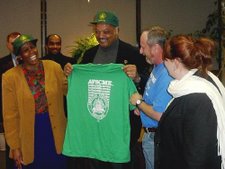
The future of the union and social justice movements lies in reaching out to college students, young workers and young voters who are energized by the election of Barack Obama.

Reaching out to young people is a top priority for AFSCME and the AFL-CIO. Speaking at the Texas state federation convention last week, AFL-CIO Secretary-Treasurer Richard Trumka, a candidate for AFL-CIO president, said:

If there’s anything our labor movement needs, it’s an infusion of younger Americans—the people whose futures are taking a beating at the hands of the Wall Street hucksters and fast-buck artists who’ve driven our economy into a ditch.

We have an opportunity, and indeed an obligation, to continue building stronger worker and student alliances in the fight for worker’s rights. To make the real changes we need, the leadership will come from working with a new generation. AFSCME Local 965 welcomes the next generation of public employees, and we are dedicated to involving this new generation of advocates for working families.


Thursday, July 16, 2009

Family-Friendly Workplaces


Today’s report by the UC Berkeley Center for Labor Research and Education and the Labor Project for Working Families comes at a seminal moment for the debate on economic and labor law reform in this country. This report emphasizes a crucial point - - that unions help families at a time when workers are forced to work more hours in an increasingly unstable environment, and as the social system in our country is being chipped away.

A unionized workplace dramatically helps working families. According to the report, unions increase compliance with the Family and Medical Leave Act, ensure paid sick leave for employees and their children, and increase the likelihood that health care is covered for families. As corporations force working people to work longer and spend more time away from their home, unions are key to creating an economy that works for everyone and ensuring that workers have flexibility in handling their family and work responsibilities. Corporations have spent billions to try to eliminate benefits like paid sick leave, time off, and health care coverage. Without workers’ freedom to form and join unions, corporations will continue to chip away at the family-friendly practices that help working people across the country.

To download “Family-Friendly Workplaces: Do Unions Make a Difference?” go to http://laborcenter.berkeley.edu or
http://www.working- families.org

--Statement by AFL-CIO President John Sweeney

Saturday, July 11, 2009

1,500 Arkansas Workers March for Free Choice


On Saturday July 11th, national labor leaders joined over 1,500 Arkansas workers in Little Rock for a rally in support of the Employee Free Choice Act, which will restore workers’ freedom to join a union and bargain for a better life.

AFL-CIO Executive Vice President Arlene Holt Baker, the first African-American executive officer of the AFL-CIO and widely known civil rights leader, joined other national labor, civil rights, and faith leaders in an historic march and rally. AFL-CIO Secretary-Treasurer Rich Trumka, Arkansas AFL-CIO President Alan Hughes, Communications Workers of America Secretary-Treasurer Jeff Rechenbach, and Steelworkers International President Leo Gerard led hundreds of union and faith and civil rights activists in the first of its kind demonstration in Little Rock.

Early Saturday morning, members of the Northwest Arkansas Labor Council and workers from all over Arkansas traveled to meet at Central High School. There, they remembered the sacrifices and contribution of the Little Rock 9 to freedom for all people in America. Led by Arkansas ministers, the assembled marched to another rally on the steps of the State Capitol featuring local faith leaders and local elected leaders in an even louder call for Senators Blanche Lincoln and Mark Pryor to vote for the Employee Free Choice Act. The marchers concluded with an old-fashioned Arkansas catfish fry at the adjacent Arkansas Education Association building.

Workers across America have launched the largest grassroots mobilization effort since the November election to pass the Employee Free Choice Act. The bill will provide workers with a greater voice on the job and will allow them to bargain collectively for higher wages, benefits, and job security. It would additionally allow for workers to join a union through majority sign up and take away the right of corporations to demand a ballot election, giving the choice of majority sign-up or an election to the workers.

Thursday, July 2, 2009

20,000 Faculty Gain Bargaining Rights


More than 20,000 faculty members at two midwestern universities are one step closer to good union contracts. Yesterday, Wisconsin Gov. Jim Doyle signed the state’s biennial budget, which includes a provision [1] extending collective bargaining rights to more than 20,000 University of Wisconsin (UW) faculty, academic staff and research assistants.

The same day, some 430 instructors and adjunct faculty at Western Michigan University (WMU) [2] voted for the Professional Instructors Organization (PIO), an [3] AFT affiliate, to represent them.

The University of Wisconsin victory capped a 40-year effort by faculty members to gain a better life by joining a union. The new law extends to 6,600 full-time, tenured and tenure-track faculty and 13,100 academic staff, which includes part-time and full-time lecturers, adjuncts, advisers, IT technicians and others. Another provision gives 3,200 research assistants the right to determine whether they want representation through the state’s first majority sign-up process.

The UW academics were the only nonmanagement public employees in the state without bargaining rights—until now. AFT-Wisconsin President Bryan Kennedy credits the continued building of workers’ political strength for the victory.

We’ve had the same legislation introduced in the three previous legislative cycles. Each time, we’ve had a chance to educate people and bring them around.

At Western Michigan University, the PIO soon will begin discussions with the WMU administration about better working conditions. Many instructors at WMU have not received any salary increase for 12 years.

Says Karl Schrock, who teaches in WMU’s School of Music:

We are confident that our organizing will help university leaders to see that part-time faculty are an essential component (along with tenure-line faculty and graduate teaching assistants) in the educational enterprise at WMU. We look forward to working with the administration to improve communication, faculty recognition and long-term planning for the university’s mission in ways that will benefit students and the university community as a whole.

These wins follow [4] several other votes in Michigan over the past two years. During that time, new unions representing contingent faculty and graduate employees have formed at Michigan State University, Central Michigan University, Henry Ford Community College and Wayne State University, all affiliated with AFT Michigan.

Article reprinted from AFL-CIO NOW BLOG: http://blog.aflcio.org/

URLs in this post:
[1] extending collective bargaining rights: http://www.aftface.org/index.php?option=content&task=view&id=546
[2] voted for the Professional Instructors Organization: http://www.aftface.org/index.php?option=com_content&task=view&id=547&Itemid=63
[3] AFT: http://www.aft.org/
[4] several other votes: http://www.aftface.org/index.php?option=com_search&Itemid=52&searchword=michigan&searchp
hrase=any&ordering=newest

Friday, June 26, 2009

National Health Care Reform


Coming from unions, community organizations and all walks of life, nearly 10,000 supporters of health care reform gathered on Capitol Hill today to send a strong message: We demand affordable, high-quality health care for all, and we aren’t waiting any longer.

Every corner of the Upper Senate Park on Capitol Hill was filled this afternoon with union members, health care advocates and community activists from across the country, and they heard from not only members of Congress and union leaders, but also from nurses, small business owners, workers and parents who told compelling stories about why we need health care reform.

Like all of the speakers, AFL-CIO Executive Vice President Arlene Holt Baker expressed confidence that we can move from an unsustainable health care system to one that protects families and covers everyone:

Health care without cost control will not work. Health care without a quality public option to lower costs is totally unacceptable.

Many rally participants are spending this afternoon at town hall meetings and on Capitol Hill lobbying members of Congress for real health care reform. In addition to the strong turnout of union members and community organizers, groups including Working America and Democracy for America brought tens of thousands of signatures they’ve collected from people across the country who say we’ve waited long enough for health care reform.

Ohio Sen. Sherrod Brown said despite determined opposition from the insurance companies that control our health care now, we have an opportunity to build on and improve our health care system:

Special interests and the health insurance industry will not hijack this process. We must have and we will have a strong public option.

Pennsylvania Rep. Allyson Schwartz said we need health care reform that controls costs to recover from today’s economic crisis:

This is such an important issue for all of us. It’s always been a moral responsibility, but it’s increasingly an economic imperative.

Other rally speakers included union leaders President Gerald McEntee of AFSCME and President Larry Cohen of the Communications Workers of America (CWA), members of the House and Senate, actress Edie Falco, former Gov. Howard Dean and leaders of a wide variety of grassroots organizations.

Thursday, June 18, 2009

Confirm Sotomayor


The International Executive Board of the American Federation of State, County and Municipal Employees (AFSCME) has unanimously declared its support for Judge Sonia Sotomayor, President Barack Obama’s nominee for the Supreme Court, and promised to help secure her confirmation by the Senate.

“President Obama’s nomination of distinguished Appeals Court Judge Sonia Sotomayor to the Supreme Court is the right move for our nation,” said AFSCME President Gerald McEntee. “Judge Sotomayor is exactly the kind of experienced, capable and fair jurist the working men and women of this nation need to serve on our highest court.”

“Judge Sonia Sotomayor has worked to preserve the rights of workers to receive fair pay, health benefits, and to be free of workplace discrimination,” said McEntee. “The Senate should promptly confirm Judge Sotomayor to the Supreme Court.”

Call Senators Mark Pryor and Blanche Lincoln, and ask them to vote to confirm Judge Sotomayor's nomination. You can reach their offices at (202) 224-3121. A switchboard operator will connect you directly with the Senate office you request.

Saturday, June 13, 2009

UA Putting Employees Last

Some staff members at the University of Arkansas will get small raises for the next school year, but they still won’t earn what the new statewide pay plan for classified employees says they should.


There are 1,577 classified employees at the university. The plan gives a boost to 386 of those employees making less than the entry-level wage, but in some cases they will still be below the entry level wages. Faculty members will not receive any raises this year.


Chancellor David Gearhart made a big deal about not raising tuition and only slightly raising student fees. “We believe this to be the only responsible course of action for us to take to support our students and their families during these difficult economic times,” said Gearhart in a letter to university employees.


Chancellor Gearhart did not say what he thought would be a responsible course of action for him to take to support faculty, staff, and their families during these difficult economic times.

Wednesday, June 3, 2009

Academics for Employee Free Choice


University of Arkansas faculty from the J William Fulbright College of Arts and Sciences and the Dale Bumpers College of Agricultural, Food and Life Sciences held a news conference on campus today. They joined university and college teachers, scholars, and research scientists from both public and private higher education institutions across Arkansas, who are calling for public policy decisions to be informed by facts. Unfortunately, the current national debate on enactment of the Employee Free Choice Act has been distorted by unsupported assertions that ignore the available empirical evidence.

Arkansas Academics for Employee Free Choice today released copies of two recent studies that directly touch on arguments being made in the national debate. The first refutes the claim that the current process is working and documents increasing employer hostility to organizing efforts (No Holds Barred). The second is a survey of four states where majority sign-up is working, and it found no instances of intimidation by either employers or unions (Majority Authorization and Union Organizing in the Public Sector). "In brief, from 2003-2009 in the states studied, a total of 34,148 public sector workers employed in state, county, municipal and educational institutions voluntarily joined a union. Most importantly, contrary to business claims, in 1,073 cases of union certification and in at least 1,359 majority-authorization campaigns, there was not a single confirmed incident of union misconduct". They expressed their hope that Senator Pryor and Senator Lincoln will take the time to review these studies and become better informed by the facts.

In addition, a recent article from the Arkansas Democrat-Gazette that points out another failure of the current process that can be remedied by the Employee Free Choice Act. Even when employees vote for union representation under current NLRB rules, there is no requirement that employers negotiate in good faith or in a timely manner. Following the article is a timeline documenting the history of one corporate employer that refused to meet with employees for over nine years, and only did so after being ordered to do so by the courts and a long, unnecessary, and expensive legal battle. EFCA would encourage more timely good faith negotiation to avoid arbitration.

Academics for Employee Free Choice sent a letter to Senators Pryor and Lincoln. It is signed by more than 40 academics from across Arkansas, including 18 at the University of Arkansas, Fayetteville. The letter clearly explains the reasons why they support enactment of the Employee Free Choice Act to make sure that the economic recovery includes everyone and allows working families to share in the American Dream of a better life for themselves and their children.

AFSCME Local 965 members Betty Martin, Michael Pierce, Lindsley Smith, Trish Starks, and Stephen Smith were among those attending and participating in today's news conference.

Sunday, May 31, 2009

This Date in Arkansas Labor History


May 31, 1936. St. Francis County Judge E. A. Rolfe and Sheriff J. M. Campbell ask Governor Futrell to send Arkansas National Guard to put down Southern Tenant Farmers Union strikers asking for higher wages.


May 31, 1960. Local Union No. 131 of the Glass Bottle Blowers Association (AFL-CIO) prevails in federal court, enforcing arbitration for claim of wrongful discharge of a union member by Arkansas Glass Container Corp.

May 31, 1965. Arkansas Supreme Court holds that involuntarily unemployed workers of the International Shoe Company were entitled to unemployment benefits denied by company after two-week shut-down of two plants in 1963.

Wednesday, May 27, 2009

Labor Vigil in Fayetteville


The Northwest Arkansas Labor Council joined with the NWA Workers Justice Center, UA Students Against Sweatshops, and the OMNI Center for Peace, Justice and Ecology for a labor action in support of enacting the Employee Free Choice Act. Twenty-six workers and supporters walked an informational picket line outside Senator Blanche Lincoln's office in the Federal Building at Fayetteville this afternoon, asking the Senator to stand up for working families and make sure that the economy works for everyone.

Senator Lincoln is one of the few Democratic members of the U.S. Senate who has refused to support the Employee Free Choice Act, despite the fact that the Washington County Democratic Central Committee, the Senior Democrats of Northwest Arkansas, the Washington County Democratic Women, and the UA Young Democrats have all overwhelmingly adopted resolutions asking her to co-sponsor the legislation and vote for cloture to stop the Senate Republicans from preventing a vote on the bill.

AFSCME Local 965 members Kasey Walker, Michael Pierce, Mark Swaney, Larry West, and Stephen Smith were among those participating in todays informational picket to remind Senator Lincoln that a majority of Americans support the Employee Free Choice Act.

Wednesday, May 20, 2009

Michael Pierce to Senator Lincoln


Please, Sen. Blanche Lincoln, change your mind on the Employee Free Choice Act.

Earlier this month, Lincoln announced that she would oppose the Employee Free Choice Act, an AFL-CIO-supported initiative that would simplify the process by which the National Labor Relations Board would certify unions as the collective bargaining agents for workers. Rather than holding costly, complicated and often drawn-out elections, the NLRB would certify a union when more than 50 percent of the employees sign union cards - a method commonly called "card check."

The best way to help Arkansans in these troubled economic times is to put more money in the pockets of those who go to work every day, and making it easier for people to join labor unions would do just that. In 2006 and 2007, unionized workers in the state - there are about 80,000 of them - averaged $17.29 per hour, and non-union workers made but $12.70 an hour. In other words, union workers made 36 percent more than non-union workers. Even within the same job categories, unionized workers make more.

In Little Rock, workers at Kroger grocery stores earn about 25 percent more than their counterparts at Wal-Mart. This is because the union that represents Kroger workers - the United Food and Commercial Workers - sees to it not only that its members receive a living wage but also that they cannot be fired for simply having accrued too many seniority raises or reaching an age that causes insurance rates to rise.

Since consumer spending represents about two-thirds of our nation's economic activity, making it easier for workers to join unions would also create more jobs - the very thing that Lincoln says is her top priority. With more money in their pockets, union families would spend more on food, clothing, computers and books, and this increased demand for goods would stimulate the economic growth needed to get the nation back on a sound economic footing.

Recent surveys suggest that more than half of American workers would join unions if given the opportunity. But currently about 12 percent of the nation's workers are union members. The major reason for this disparity is simple: the process by which the National Labor Relations Board certifies unions provides too many opportunities for companies to coerce those seeking to join unions. Elections to certify unions are held on company premises. Employers threaten their employees that they will lose their jobs if the union is certified. Legal challenges drag out the process in hopes that employees will give up in their attempt to organize, and workers are often forced to sit through sessions designed to intimidate them. This is the process that the Employee Free Choice Act seeks to simplify.

The opponents of the Employee Free Choice Act - among the most strident are Wal-Mart, The Home Depot and bailout poster child Bank of America - have been disingenuous in their opposition. Instead of telling people the real reason that they oppose card check - they don't want to pay their employees higher wages and they want to be able to fire workers without due process - these companies have hid behind claims of wanting to preserve the "secret ballot."

Arkansans should remember, though, that the secret ballot does not guarantee free or fair elections. For political elections, the state introduced the secret ballot (also called the Australian ballot) in 1892 specifically to stop blacks and poor whites from voting. A Democratic campaign song that year explained:

The Australian ballot works like a charm,

It makes them think and scratch,

And when a Negro gets a ballot

He has certainly met his match.

As Harvard University historian Jill Lepore has written, "The year after Arkansas passed its Australian-ballot law, the percentage of black men who managed to vote dropped from 71 to 38." The total white vote declined by more than 25 percent, with the poor making up most of those disenfranchised. In other words, history makes clear that the secret ballot can be used to some very undemocratic ends.

A strong labor movement is good not only for union members but for all Arkansans. Over the course of the 20th century, the Arkansas labor movement was at the forefront of nearly every positive reform in the state, reforms that were denounced as "too radical" by the economic elite at the time but are now taken for granted. In the century's first two decades, the Arkansas State Federation of Labor helped push through direct legislation, child labor laws, educational reforms, women's suffrage, maximumhours laws and minimum-wage legislation. In the 1930s, it was the architect of the state's workers' compensation and unemployment plans. In the postwar years, it led the way in integrating public facilities, increasing aid for education, fighting for the repeal of the poll tax and opposing the doctrines of nullification and interposition that the segregationists wanted to use to keep African-Americans second-class citizens.

A vibrant labor movement is Arkansas' best hope for a progressive future.

· · ·

Dr. Michael Pierce is an assistant professor of history at the University of Arkansas at Fayetteville, where he teaches Arkansas history and serves as associate editor of the Arkansas Historical Quarterly. He is a member of AFSCME Local 965.

This entry originally appeared in the Benton County Daily Record, May 10, 2009.

Women Workers Less Likely to Have Secure Retirement


Women workers are less likely than men to have enough money to retire comfortably because they generally live longer than men and earn less on the job, according to a new report. It will take a three-pronged approach to help women have a secure retirement, the report says: traditional pensions, supplemental 401(k)-type savings and Social Security.

Shattering the Retirement Glass Ceiling: Women Need a Three-Legged Stool,” released this month by the non-profit research group National Institute on Retirement Security (NIRS), found that because of her longer life expectancy, a woman with an annual income of $50,000 would need to save $1,000 more toward retirement every year than her male counterpart to have an equal retirement experience. Yet, more than 45 years after the Equal Pay Act was signed, women in the United States still earn only 78 cents for every dollar men earn—even with similar education, skills and experience—and African American and Hispanic women earn even less. The wage difference makes saving money more difficult for many women.

Friday, May 1, 2009

Celebrating May Day


May 1, 1886, became historic. On that day thousands of workers in the larger industrial cities poured into the streets, demanding eight hours. About 340,000 took part in demonstrations in Chicago, Milwaukee, Detroit, Cincinnati, St. Louis, Baltimore, Washington, New York, Philadelphia, Boston and other places. Of these nearly 200,000 actually went out on strike. About 42,000 won the eight-hour day. Another 150,000 got a shorter day than they had had before.

Chicago workers supported the movement most vigorously. To combat labor organization and activity, Chicago employers organized and acted. Pinkerton detectives and special deputies were in evidence. Policemen were swinging billies and breading up knots of workers on street corners.

At the factory gates of McCormick Harvester Co., where a strike meeting was being held on May 3, policemen swung their clubs and then fired into the running strikers....The speaker at the meeting was August Spies, a member of the Central Labor Union, which had supported the May First strike. He was also a member of a militant labor group that was at the time influential in the Chicago Labor movement. Six workers were killed that day and many wounded.

Anger ran high through the Chicago labor movement. About 3,000 attended a protest meeting the next day at Haymarket Square....The Chicago press reported the speeches were less "inflammatory" than usual. Mayor Carter H. Harrison who was present testified later that the meeting was "peaceable." But as it was about to adjourn, policement swooped down and ordered the audience to disperse. Then some unknown person threw a bomb. It exploded, killing a police sergeant and knocking several core to the ground. The police opened fire. At the end of the day, seven policemen and four workers lay dead.

At once several Chicago labor leaders were rounded up and thrown in jail. Eight of these finally came to trial--Albert Parsons, August Spies, Louis Lingg, George Engel, Michael Schwab, Samuel Fieldon, Adolph Fischer and Oscar Neebe. The presiding judge helped pick the jury which was strongly anti-labor and hostile to the defendants. The trial lasted 63 days. All of the men were declared guilty of murder. All were given death sentences, except Neebe who got a 15-year prison sentence.

A nationwide defense campaign won wide popular favor...At the last moment, as a result of widespread protests, the Governor of Illinois communted to life imprisonment the sentences of Fieldon and Schwab. It was reported that Lingg "committed suicide" in his cell.

On November 11, Albert Parsons, August Spies, Adolph Fischer and George Engel were hanged. On the gallows Spies cried, "There will be a time when our silence will be more powerful than the voices you strangle today." Straightway the defense movement, now led by Albert Parsons' widow, Lucy Parsons, turned to efforts to have the remaining three men freed. Fieldon, Schwab and Neebe were finally pardoned by Governor Altgeld in 1893. He was fully convinced, he said, of the innocence of all the eight men.

Out of the eight-hour struggle which culminated in the strike of May 1, 1886, and its aftermath, the Haymarket tragedy, came international May Day. In Paris, France, on July 14, 1889, leaders from organized proletarian movements in many countries came together to form once more an international association of workers....At the first congress of the Second International, delegates listened to the story related by the United States representatives, considered a request from the American Federation of Labor for support of their eight-hour fight, and voted to make May 1, 1890, a day for an international eight-hour day demonstration.

--Holt Labor Library