Thursday, May 10, 2007

Cynthia Nance Receives Fletcher Award


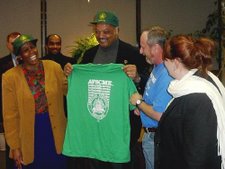
AFSCME Local 965 member Cynthia Nance received the Arthur A. Fletcher Lifetime Achievement Award from the American Association for Affirmative Action, presented at the association's annual conference last month in Austin, Texas. Nance was also a keynote speaker at the conference.

The award is named after the "Father of Affirmative Action," Arthur A. Fletcher. Fletcher served as assistant secretary of the U.S. Labor Department during the Nixon administration and is given credit for creating the Philadelphia Plan, the first affirmative action program that established employment goals for federal contractors in the construction industry. He devoted his life to preserve the promise of the Constitution for all Americans. The Arthur A. Fletcher Lifetime Achievement Award was established to recognize individuals who, like Fletcher, have devoted a lifetime of service and dedication to the principles of affirmative action - access, equity and diversity.

Wednesday, May 9, 2007

City Planners in Fantasyland

Leif Olson, long-range planner for the city, yesterday said attainable workforce housing in Fayetteville would have a maximum price range of about $131,000 to $197,000. City Council members from Wards 1, 2, and 4 disagreed.

Olson said that according to the Department of Housing and Urban Development, the 2007 median family income for a family in Benton or Washington counties is $53,100. He chose not to use Fayetteville residents for the calculation, saying there were many students but ignoring the huge salaries paid to UA administrators and football coaches who it seems almost outnumber students. Instead, he chose to throw in Benton County with thousands of Wal-Mart executives and suppliers, J.B. Hunt trucking executives, and the McMansions in gated communities like Pinnacle where even one UA administrator maintains a home.

Using Planner Olson’s chosen two-county area, the definition proposed for attainable workforce housing bracketed that median income with ranges of 80% to 120% — or $42, 480 to $63,720. Possible house prices for those groups, based on the proposed definition and applying conservative amounts to a mortgage calculator, ranged from about $134,000 to $204,000.

Here’s something Leif Olson and whomever hired him need to consider. Real jobs held by real people. The following seven job openings are currently advertised by the University of Arkansas.

Custodial Worker II Annual Salary: $16,125.00

Library Supervisor I Annual Salary: $24,131.00

Maintenance Worker II Annual Salary: $16,500.00

Public Safety Officer I Annual Salary: $22,859.00

Skilled Trades Worker Annual Salary: $24,131.00

Secretary II Annual Salary: $18,903.00

Accountant Annual Salary: $25,897.00

How much can these folks pay for housing? What is the average price of a home they could afford, and how many of those do you think are currently available in the Fayetteville city limits?

We face three options: (1) Pay employees a living wage; (2) build housing that working families can afford; or (3) turn Fayetteville into an enclave for the wealthy who are serviced by a commuting workforce.

Tuesday, May 8, 2007

Fayetteville's Affordable Housing Crisis

AFSCME Local 965 has long been an advocate for affordable workforce housing in Fayetteville, a cause championed by Alderman Lioneld Jordan. The Fayetteville City Council will consider this week a report on Fayetteville Attainable Workforce Housing Policy and consider available policy options. Past discussions have been about affordable housing, attainable housing and workforce housing, now combined into attainable workforce housing. One of the possible policy alternatives combines all three. It calls for the city to ensure that attainable workforce housing remains affordable.

At past Council and Planning Commission meetings, developers have talked about affordable, moderate, workforce or attainable housing price ranges from less than $120,000 to $150,000, depending on the development. One area banker identified the $150,000 to $175,000 range as affordable, and a local developer said that $180,000 homes were not affordable but were more attainable than some of the other homes built in the city.

An individual earning 80% of the area median family income could afford a home costing about $100,000 to $115,000, according to Tim Conklin, planning director for the city. HUD identified median family income for the Fayetteville Metropolitan Statistical Area as $47,400, so the 80% to 120% range of that is an annual family income of $37,920 to $56,880 per year.

The generally accepted definition of affordability is for a household to pay no more than 30 percent of its annual income on housing. Families who pay more than 30 percent of their income for housing are considered cost burdened and may have difficulty affording necessities such as food, clothing, transportation and medical care. An estimated 12 million households now pay more then 50 percent of their annual incomes for housing, and a family with one full-time worker earning the minimum wage cannot afford the local fair-market rent for a two-bedroom apartment anywhere in the United States. The lack of affordable housing in Washington County (and specifically in Fayetteville) is a significant hardship for low-income households preventing them from meeting their other basic needs, such as nutrition and healthcare, or saving for their future and that of their families.

The lack of affordable housing is also a hardship on Fayetteville city employees and UA staff who cannot buy a home in town near their jobs. This means higher fuel and transportation costs, as well as increased parking fees. All indications are that the affordable housing shortage in Fayetteville will continue to grow. The longer the City waits to address this issue, potentially the more painful it could be to resolve. We need bold leadership and immediate action to solve this crisis.

Friday, May 4, 2007

Local Union Helps "Stamp Out Hunger"

The Fayetteville Local of the National Association of Letter Carriers (AFL-CIO) announced that the nation’s largest food drive to combat hunger will be conducted this year on Saturday, May 12 in all 50 states. On that day, local letter carriers will collect non-perishable donations as they deliver mail along their postal routes.

NALC President William H. Young noted that the upcoming summer months “are a particularly critical time for millions of children whose school lunch programs are suspended until fall and their families must find alternate sources of nutrition. Letter carriers see these families every day as they deliver the mail,” Young said. “This food drive is one way we can help alleviate their plight and we encourage our postal patrons to participate by leaving donations by their mailbox on May 12.”

AFSCME Local 965 supports this effort by our brothers and sisters in the local letter carriers union, and we ask our members to leave non-perishable donations – such as canned meat, fish and soup, and cereals, pasta and rice – in a bag near their mailbox on Saturday, May 12 before their letter carrier arrives. It will be taken to the local post office and then delivered to a local food bank, pantry or shelter.

The 15th annual NALC National Food Drive is the largest one-day food drive in the nation. The food will be collected in over 10,000 communities by nearly 1,500 local branches of the postal union, along with rural carriers and other volunteers. Since its inception in 1993, the nationwide drive has collected and delivered over three-quarters of a billion pounds of food—765.5 million pounds—to help hungry families.

Thursday, May 3, 2007

Even the UA Students Get It

The UA student newspaper, the Arkansas Traveler, published a front-page article yesterday with the headline: "Report finds equal pay for equal work still an issue at UA." The lead paragraph said, "On Equal Pay Day, April 24, UA Chancellor John A. White found out from the Arkansas Public Employees Union that pay on the UA campus was not equal at all. In fact, the union believes that there is some sort of sex discrimination present at the UA."

The student reporter noted , "
The Committee to the Faculty Senate revealed that there is an increasing gender-based wage gap among UA faculty members in positions ranging from instructor to professor. The wage gap for women is worst at the assistant professor level, which includes most hires within the last seven years."

There was no comment from Chancellor White or any Administration functionary. Neither has AFSCME Local 965 received any reply or explanation requested in the April 24th request to John White.

Wednesday, May 2, 2007

NWA Times: UA Short-Changes Women


The Northwest Arkansas Times editorial today comments on the salary disparity for women faculty at the University of Arkansas. This is an issue of serious concern for AFSCME Local 965 and all UA employees. The UA Administration that created and perpetuated the situation seems to think they can ignore the problem and continue business as usual. The questions we asked more than a week ago have gone unanswered, but those questions remain on the mind of both taxpayers and the media. Here's what the NWA Times has to say:

"The UA — THE bastion of liberal thought and theory in Northwest Arkansas. THE supposed safe place where citizens of every shape and size are sure to fit in. Everyone but women, that is. A recent report presented to the UA’s Faculty Senate suggests the pay gap between the sexes at the state’s flagship university is actually widening. For instance, the report cited an $ 11, 000 difference between male and female assistant professors. This suggests an imbalance that’s reflective of a national trend that goes well beyond conspiracy theorists who believe the UA is out to get its female employees. According to the U. S. Department of Labor, women who work full-time jobs in America earn 75 cents for every dollar that a man earns,
and the gap is larger for women of color. ...

"Fayetteville students taking courses in American government might be especially confused, since they may have recently read about the Equal Pay Act of 1963, which was supposed to make it illegal to pay women less than men for work that is “ substantially equal” unless differences in pay are based on extenuating circumstances, such as experience or seniority. Apparently much of America has yet to get Uncle Sam’s drift. Equally aggravating is that universities and corporations can’t realistically snap their fingers and do away with pay inequity just like that. A problem such as this is a generational affair, with pay inequity building upon itself so that women never come close to catching up. The nation has made progress, but nobody should assume gender discrimination has disappeared. Make no mistake about it, though: It is particularly embarrassing that a major campus in a university town is paying some of its female employees less than their male peers. With all the supposedly progressive thinking college campuses are known for, it seems UA officials should know better. ...

"Today America, and the UA, make due with inequalities in pay, but future generations may look back at such practices as warped in its sense of justice. Someone needs to offer an explanation of why disparities continue and what it will take to fix them. Someone being paid less based solely on gender surely cannot be expected to display patience and understanding while a system of inequity continues to exist. Surely men can understand how unjust this is. How many men can honestly say they’re comfortable that their daughters will be paid unfairly simply because of who they are? None we can think of."

Solidarity Supper

No ticket to buy, no need to dress up. All you need to do is go enjoy a festive dinner of great Mexican food between 5 pm - 9 pm this Wednesday, May 2, at either location of Oseguera’s restaurant -- 1100 48th Place in Springdale or 3223 North College in Fayetteville

Thanks to the generosity of the Oseguera family, 10% of the night’s receipts will go to benefit the Northwest Arkansas Interfaith Worker Justice Center, Please help the cause and support this effort by dining out in solidarity with NW Arkansas’s immigrant workers and in support of International Labor Day.

Tuesday, May 1, 2007

The Forgotten History of May Day


May Day: The holiday of the workers. In days gone by, when men, women and children often worked 10 or more hours a day, seven days a week, May Day was an assertion on the part of wage-slaves that they were sovereign human beings with control over their own lives and destinies. They celebrated the day with marches of tens and hundreds of thousands throughout the world.

May Day was an expression of the international solidarity of the working class. "Workers of the world unite, you have nothing to lose but your chains," was not just a slogan. It was a battle cry in the war between classes. Their marches and rallies, with fiery speeches, impassioned poetry and stirring anthems, gave them a sense of their collective strength. It was an act of defiance of the combined forces of employers and public authorities. Often their gatherings were brutally attacked by police or thugs with clubs and guns.

Although not often taught in American history classes, May Day originated in the United States during the campaign for an eight-hour day. The Knights of Labor, the nascent American Federation of Labor and various anarchist groups designated May 1, 1886, for nationwide demonstrations for the eight-hour goal.

The response of the "bosses," political and economic, was extreme repression to silence the most vocal and active labor advocates. An increasingly conservative Samuel Gompers and AF of L had by the mid-1890s distanced themselves from May Day and embraced the legally sanctioned Labor Day, which was observed the first Monday in September. The aspiration for the unity of workers was shattered by these developments.

Meanwhile, the Bolshevik Revolution turned out to be a Trojan horse in the socialist camp, as the Leninist-Stalinist regime proved to be a ruthless dictatorship presiding over state capitalism. May Day was hijacked by the Soviet Union with its displays of military prowess in Red Square. The association of May Day with Soviet Communism has given it a bad name to this day.

In this age of globalization, when workers are pitted against each other, across oceans and continents, we have returned to conditions of pitiless exploitation of human beings. If greed ever was constrained by patriotism, it certainly is not today. It is time to revisit May Day in the spirit in which it was conceived over a hundred years ago. Only an international labor movement can hope to match the prowess of the amoral trans-national capitalist system.

Excerpt from Rudolph J. Vecoli, "Mass Amnesia Makes Americans Forget the Story behind May Day,"
Barre Montpelier Times Argus, April 26, 2007

Friday, April 27, 2007

The Protecting America's Workers Act

Tomorrow, workers and safety advocates from around the world will observe Workers Memorial Day—a day to honor the thousands of workers who are killed or hurt on the job each year.

The day of recognition comes only days after a New York Times article revealed how the Bush administration has placed worker safety “in the hands of industry.” Under President Bush, the Occupational Safety and Health Administration (OSHA) “has killed dozens of existing and proposed regulations and delayed adopting others,” the Times said. Since Bush became president, “OSHA has issued the fewest significant standards in its history, public health experts say. It has imposed only one major safety rule. The only significant health standard it issued was ordered by a federal court.”

Government records show that in 2005, more than 6,800 workplace-related deaths occurred, along with 4.2 million injuries and illnesses. Labor leaders and health experts say those numbers significantly undercount the problem, in part because the Bush administration has reduced the categories of recognized injuries and because many dangerous jobs are now performed by undocumented workers who do not report problems.

You can do something about it. Tell our senators and representative to co-sponsor the Protecting America’s Workers Act, S. 1244 and H.R. 2049. The bill would expand OSHA protections to millions of uncovered workers, enhance whistleblower protections and substantially increase penalties for serious, willful and criminal safety violations.

You can send an e-mail to Senator Pryor, Senator Lincoln, and Rep. Boozman by clicking here.

Thursday, April 26, 2007

Candlelight Vigil in Memory of Workers

The Northwest Arkansas Workers Justice Center is remembering and honoring Arkansas workers who have been killed on the job and those who have been injured by accidents or diseases in the workplace. They are sponsoring a Candlelight Vigil on Tuesday, May 1st, at 8:00 p.m. in Murphy Park, Springdale, and they invite everyone to join in memorializing the Arkansas workers who have lost their lives or given their health on the job this past year.

This will be the main public event for Workers Memorial Day in Northwest Arkansas.
It is an opportunity to join with other working families and give tribute to those workers who came before us and struggled for justice.

For additional information about the vigil or to learn more about the Northwest Arkansas Workers Justice Center, call 759-8015, drop by their office at 2200 W. Sunset in Springdale, or email Rachel Townsend at
rtownsend@nwawjc.org

Tuesday, April 24, 2007

Local 965 Has Questions for Chancellor

In response to the Report from the Financial Advisory Committee to the UA Faculty Senate on April 18th documenting that women faculty members are paid less than their male colleagues at every academic rank, the following letter was sent to UA Chancellor John A. White. AFSCME Local 965 is very concerned about the findings in the Report, and we are seeking additional information as well as offering our support in efforts to correct current salary inequities.
__

Dear Chancellor White:

Today is Equal Pay Day. The date—Tuesday, April 24th—symbolizes the fact that on average, a woman must work for a year and four months to earn the same wages as a man receives in a year.

The Equal Pay Act of 1963 made it illegal to pay women less than men for work that is “substantially equal,” unless the pay difference is because of legitimate factors such as seniority or experience, but wage discrimination based on sex still exists in the workplace. Now, 44 years later, a Report last week from the Financial Advisory Committee to the Faculty Senate revealed that the wage gap still exists for women faculty members--at all ranks from Instructor to Full Professor--at the University of Arkansas and that it is actually increasing.

The wage gap for women faculty members appears especially egregious at the Assistant Professor level that includes most hires within the last seven years, where seniority and experience are not significant factors. Assuming that a female Assistant Professor hired at 30 years of age remained at the University of Arkansas until retirement at age 65, the present $11,000 salary gap could be projected at $385,000 by time of retirement, even if women faculty received raises equivalent to their male colleagues.

The members of Local 965, American Federation of State, County, and Municipal Employees, representing employees at the University of Arkansas oppose sex discrimination in employment and strongly support equal pay for equal work. We were both surprised and shocked to see the documentation of salary discrepancy that exists between male and female faculty on our campus. We are committed to working with you and your administration to address and eliminate this gender-based salary gap among the faculty at the University of Arkansas .


Equal pay is not only about basic fairness; it’s also about basic family economics. The earnings of many of these working women are essential to supporting a family. For every dollar lost because of the salary discrepancy, that is one dollar less that our female faculty members have to spend on groceries, housing, child care, retirement contributions, and other family expenses--$11,000 less for female Assistant Professors.

We would be very interested in your response to the Report of the Faculty Senate Financial Advisory Committee, especially:

(1) (1) Are the data presented in the Report reasonably accurate, and, if not, can the administration provide more accurate data?

(2) (2) If the Report presents reasonably accurate data, how can you explain the significant salary gap between male and female faculty members?

(3) (3) If the Report presents reasonably accurate data, who was responsible for approving the initial salaries that resulted in the differential salary gap between male and female faculty?

(4) (4) If the Report presents reasonably accurate data, how can you explain the recent increases in the salary gap between male and female faculty?

(5) (5) Of the 28 upper level administrators noted in the Report, how many of those positions are held by women in each group?

(6) (6) Of the 28 upper level administrators noted in the Report, what are the average salaries of male and female administrators in each group?


Thank you for your time in reading this message and considering our questions. We look forward to receiving your responses to our questions and concerns and to working with you to achieve equal pay for women and fair pay for everyone on our campus.


Sincerely,

Stephen Smith
President
AFSCME Local 965

Monday, April 23, 2007

Equal Pay Day

April 24th is Equal Pay Day, declared such by the American Association of University Women which strongly supports efforts to close the persistent wage gap between men and women. AFSCME Local 965 joins their effort to remind the country and our leaders that equity is still an issue, and equal pay is essential in eliminating wage discrimination.

New research released today by the American Association of University Women Educational Foundation shows that just one year out of college, women working full time already earn less than their male colleagues, even when they work in the same field. Ten years after graduation, the pay gap widens. This is not good news for UA women students.

In the report, Behind the Pay Gap, the AAUW Educational Foundation found that just one year after college graduation, women earn only 80 percent of what their male counterparts earn. Ten years after graduation, women fall further behind, earning only 69 percent of what men earn. Even after controlling for hours, occupation, parenthood, and other factors known to affect earnings, the research indicates that one-quarter of the pay gap remains unexplained and is likely due to sex discrimination.

The reality of wage discrimination against women at the University of Arkansas was made abundantly clear last week in a report to the Faculty Senate. Women faculty members make less than their male colleagues at every academic rank--from instructor to full professor. Among faculty hired in recent years at the Assistant Professor level, women faculty make only 83 cents for every dollar paid to male faculty.

This practice of sex discrimination must stop. The UA Administration owes women faculty an immediate explanation of why they are paid less, and Chancellor White should move immediately to assure pay equity for women.

Workers' Memorial Day - April 28th

The first Workers Memorial Day was observed in 1989. April 28 was chosen because it is the anniversary of the Occupational Safety and Health Administration and the day of a similar remembrance in Canada. Every year, people in hundreds of communities and at worksites recognize workers who have been killed or injured on the job. Trade unionists around the world now mark April 28 as an International Day of Mourning.

Decades of struggle by workers and their unions have resulted in significant improvements in working conditions. But the toll of workplace injuries, illnesses and deaths remains enormous. Each year, thousands of workers are killed and millions more are injured or diseased because of their jobs.

On April 28, AFSCME Local 965 and the unions of the AFL-CIO observe Workers Memorial Day to remember those who have suffered and died on the job and to renew the fight for safe workplaces. We will fight to make workers’ issues a priority and to keep and create good jobs in this country. We will fight for the freedom of workers to form unions and, through their unions, to speak out and bargain for safe jobs, respect and a better future for our families. We will demand that the country fulfill the promise of safe jobs for all workers. It’s time.
The theme of this year’s Worker Memorial Day is “Good Jobs. Safe Jobs. It’s Time.” We urge our members to get involved and organize actions, activities, or observances in our campus workplaces and our communities.

The Arkansas AFL-CIO, the UALR Labor Education Project, and the Arkansas Interfaith Committee for Worker Justice will sponsor a public ceremony at Riverfront Park in North Little Rock. Rev. Steve Copley of Arkansas Interfaith Committee for Worker Justice will preside, and we will be reading the names of those Arkansas workers who have died on the job this past year. We have found that families of union members who died on the job do appreciate being asked to participate. They can't always come, but when they do, they find the ceremony dignified and consoling. If you know someone who has been hurt on the job or a family of someone who lost their life on the job, please ask them to join us.

Friday, April 20, 2007

Curb the Clutter -- May 5th

Litter is a problem for communities of all sizes, and only with the help of all of its citizens can a community hope to keep their environment clean and beautiful. AFSCME Local 965 is helping to take collective responsibility for our environment by participating in the City of Fayetteville’s Curb the Clutter program. This program provides us with the opportunity to perform a worthwhile community service that enhances the public image and natural beauty of our campus and our community.


AFSCME Local 965 members have adopted a section of Razorback Road from 6th Street to Cleveland for the purpose of litter control, to increase public awareness of the monumental task of managing Arkansas' rights-of-way, and to promote public involvement. Not only does roadside litter detract from our State's natural beauty, it costs Arkansas taxpayers over $2 million annually to pick up. In 2004, more than 85 tons of litter was collected from city streets in Fayetteville. The Curb the Clutter programs provide a mechanism for our union members to address this problem and become personally involved in improving our campus, our community, and our environment.

Our next pick-up date is scheduled for 7:00 a.m. on Saturday, May 5th. Meet at the physical plant parking lot on Razorback Road. Safety vests and litter bags will be provided for all participants.

Local 965 Officers for 2007-2008

AFSCME Local 965 held elections for officers, executive board, and trustees at the regular monthly meeting on April 19th. The following members listed below were elected to serve you for the upcoming year.

The Local officers have a deep sense of responsibility to the entire membership, and they work diligently to ensure that your interests are protected. They attend regular seminars and workshops, keeping up to date on the various issues, laws, and changes that have an impact on our members. The Local officers have an earnest desire to help our University employee members change things for the better, something we've been doing since 1963. They work for legislation to protect members' rights, and they articulate the needs and interests of University employees that are so often overlooked or ignored by administrators.

They are always available to answer any question, help with any problem, or assist in any way they can. The officers of Local 0965 firmly believe that the members are our first priority. You are not outsiders in our union business; you are our union’s business. We have given them an opportunity to serve us for the upcoming year, so please let them know how they can help you.

Canfield, Randy (Trustee-2008)

Hill, Paul (Executive Board-2)

Ferguson-Rivers, Fillan (Executive Board-4)

Jongewaard, Joni L (Trustee 2010)

Jordan, Lioneld (Delegate to Council 38)

McNully, Bruce W (Treasurer)

Martin, Betty (Vice President)

Morris, Dwight (Executive Board-3)

Nance, Cynthia (Executive Board-1)

Sims, Theresa (Secretary)

Smith, Stephen (President)

West, Larry D (Trustees-2009)

Thursday, April 19, 2007

Home Foreclosures Up 47% in March

Foreclosure filings in the United States jumped 47 percent last month from a year ago as the housing slump continued to take its toll on homeowners, with more than 149, 000 filings posted in March. In Arkansas, 505 familes faced home foreclosures in March.

The number of owners making late payments on mortgages is at a four-year high and many borrowers are unable to refinance their debt because the value of their homes has stagnated or fallen. With the failure or sale of 50 subprime mortgage companies, which provide loans to people with poor or incomplete credit, there’s also less money available for lending.

“Foreclosure activity shifted into a higher gear in the first two months of 2007, and March’s numbers continued that trend,” said James Saccacio, chief executive officer of RealtyTrac. Nationally, one of every 775 households moved into the foreclosure process, which can range from default notices for late payment to auction sales and bank repossessions. Banks typically start the process after mortgage payments are 90 days late.

Families in Poverty Surge Under Bush

Poverty in America is much more widespread than has been previously acknowledged. According to the Census Bureau, nearly 37 million Americans — 12.6 percent of the population — were living in poverty in 2005. That means that four years into an economic expansion, the percentage of Americans defined as poor was higher than at the bottom of the last recession in late 2001, when it was 11.7 percent. But that’s not the worst of it.

The measurement criteria recommended by the National Academy of Sciences show a 2005 poverty rate of 14.1 percent. That works out to 41.3 million poor Americans, 4.4 million more than were officially counted.

Lawmakers must listen to what the new numbers are telling them. They must also realize that improvements in antipoverty programs — such as expanding the earned income tax credit for the working poor and providing better early education — are some of the best investments the nation can make. And we need economic policies and budget priorities that consider jobs for American workers more important than tax cuts for corporate executives.

Wednesday, April 18, 2007

April Monthly Meeting -- April 19th


The regular monthly meeting of AFSCME Local 965 will be held at 4:15 on Thursday, April 19th, at Jim's Razorback Pizza on West 6th Street. In addition to other regular business, we will be electing officers for the coming year, so please try to attend and make your voice heard in choosing our local union leadership.

Pizza will be provided. Beverages on your own.

Bring a new member! We will have membership cards available.

Monday, April 16, 2007

Arkansas Legislative Wrap-Up

The recent legislative session can be considered a success for working families and for AFSCME Local 965 and District Council 38. Thanks to each of our members who joined this fight for working families and contacted our legislators.

Here’s how our local legislators voted on the AFSCME Local 965's ten targeted bills affecting working families:

Rep. Lindsley Smith (D-Fayetteville) 100%

Rep. Jim House (D-Fayetteville) 70%

Sen. Sue Madison (D-Fayetteville) 70%

Rep. Marilyn Edwards (D-Fayetteville) 60%

Rep. Mike Kenney (R-Siloam Springs) 50%

Rep. Eric Harris (R-Springdale) 50%

Sen. Bill Pritchard (R-Elkins) 50%

Rep. Mark Martin (R-Prairie Grove) 50%

Rep. Jon Woods (R-Springdale) 40%

Of the 16 bills on which we took a position and contacted legislators, 10 became law—7 that we supported and 3 that we opposed. Six additional bills that we supported faced strong opposition from business interests and did not make it out of committee.

New Laws Supported by AFSCME 965

ACT 1028 Paid leave for UA employees to participate in child’s educational activities

ACT 110 Cuts state sales tax on groceries from 6% to 3%

ACT 1205 Alternative dispute resolution for public employee grievances

ACT 195 Provides state income tax relief for low income families

ACT 551 Creates Workforce Service Training Trust Fund

ACT 1030 Need-based college scholarships for low income students

ACT 1599 Assures solvency of workers’ Death and Total Disability Trust Fund

New Laws Opposed by AFSCME 965

ACT 707 Freezes minimum wage for tipped employees at $2.62

ACT 545 Exempts numerous jobs from state minimum wage

ACT 1415 Abolishes Workers Comp Second Injury Fund

Other Bills Supported by AFSCME that were not enacted

SB248 ( Madison ) Regular and uniform wage payment policies

HB1204 (D Johnson) Provide UA employees defined benefit retirement plan

HB2772 (Smith)Provide family maternity leave for new employees

HB2532 (Smith) Protect Worker Comp claimants from retaliatory discrimination

HB2533 (Smith) Provide Worker Comp coverage of mental illness or injury

HB2247 (Smith) Allow city zoning for affordable workforce housing

Wednesday, April 11, 2007

Spring Picnic this Sunday


The AFSCME Spring Picnic for UA faculty and staff will be this Sunday, April 15th, 10:00-2:00, at Agri Park (North Garland).


Hamburgers, hot dogs, chips, and drinks provided by AFSCME Local 0965. Bring the whole family for an afternoon of food, fun, and fellowship with your union brothers and sisters!

Open to all UA employees, not just members!! Bring your FAMILY!! Games!! Food!!